Progress on US-China Commitments, USCC Publishes Annual Report
This week, the United States and China continued to take action on commitments made during the leaders’ meeting in October.


At the annual two sessions meetings earlier this month, China unveiled its 2025 government budget, detailing its spending priorities for the year. Aligned with the themes of the Government Work Report, which includes the highest projected deficit-to-GDP ratio in three decades, the budget enables greater spending to allow for a more proactive fiscal policy.
President Donald Trump on Tuesday followed through on his threat to increase the baseline tariff rate on all Chinese products from 10% to 20%, effective immediately. The announcement cites China’s inaction to stop the flow of fentanyl precursor chemicals to North America. The administration has not indicated plans for an exclusion process.
On March 5, Premier Li Qiang opened the annual National People’s Congress by delivering the Government Work Report. The report was released in tandem with the National Development and Reform Commission’s draft plan for economic and social development and the Ministry of Finance’s draft central and local government budgets.
The White House last Friday announced the America First Investment Policy, a national security-focused presidential memorandum that promotes investments from allies while restricting investments from adversaries, notably China.
The Trump administration’s approach to trade with China is a tangled web of existing and potential future trade actions. While there has not been a coordinated effort to clarify exactly how the administration will roll out new actions, the threat still looms.
Senior Chinese policymakers are once again signaling their embrace of the foreign business community with a new action plan for boosting foreign investment in China. The plan marks a focused government effort to incentivize more foreign participation in the China market and identifies a range of investment opportunities in mostly services sectors.
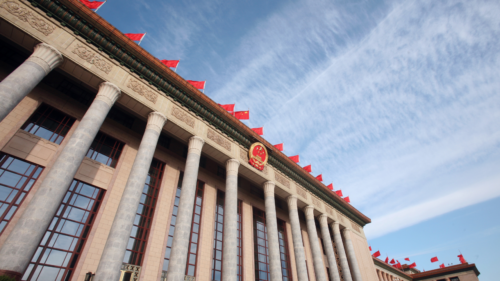
The Chinese People’s Political Consultative Conference will begin on March 4, followed by the National People’s Congress (NPC) on March 5. Together, these meetings—known as the “two sessions”—serve as China’s most important annual political event, shaping the direction of national economic and social policy.
The Shanghai Free Trade Zone (FTZ) and associated Lingang New Area recently introduced the first batch of general data negative lists for cross-border data transfers (CBDTs). The lists cover both “personal information” and “important data” in reinsurance, international shipping, retail, catering, and hospitality.
China has developed a sophisticated set of retaliatory tools that it is utilizing with greater frequency and severity as trade and technology competition with the United States intensifies. Policymakers in China do not publicly define these tools as intrinsically retaliatory.